


If you have ever felt like your body fights tooth and nail to hold onto every calorie while your friends seem to eat whatever they want, you aren’t imagining things. You are likely fighting a ghost from the past (wayy past your grandparents so dont blame them), a biological program running on an operating system designed for a world that no longer exists.
Today, we are decoding Ghrelin or “hunger hormone”, and its strange, paradoxical behavior in South Asians.
Most people think obesity comes from having too much hunger hormone. But in the South Asian “thin-fat” phenotype as we covered at the beginning of this blog, the story is often the opposite. And understanding this difference is the key to unlocking your metabolic health.
The “Grow” Hormone
lets start with the basics. Ghrelin is often called the “dinner bell” of the body. Produced primarily in your stomach, it travels to the brain to deliver a simple message: “We are empty. Find food.”
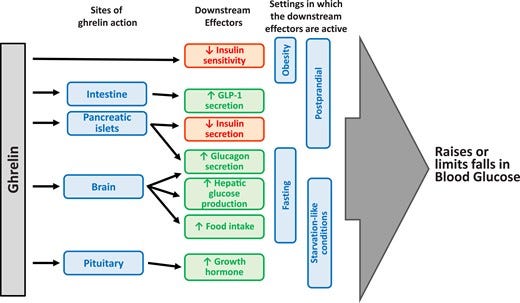
But Ghrelin has a secret second job, hidden right in its name. The word comes from the Proto-Indo-European root ghre, meaning “to grow.”
Why? Because Ghrelin is a potent trigger for the release of Growth Hormone (GH).
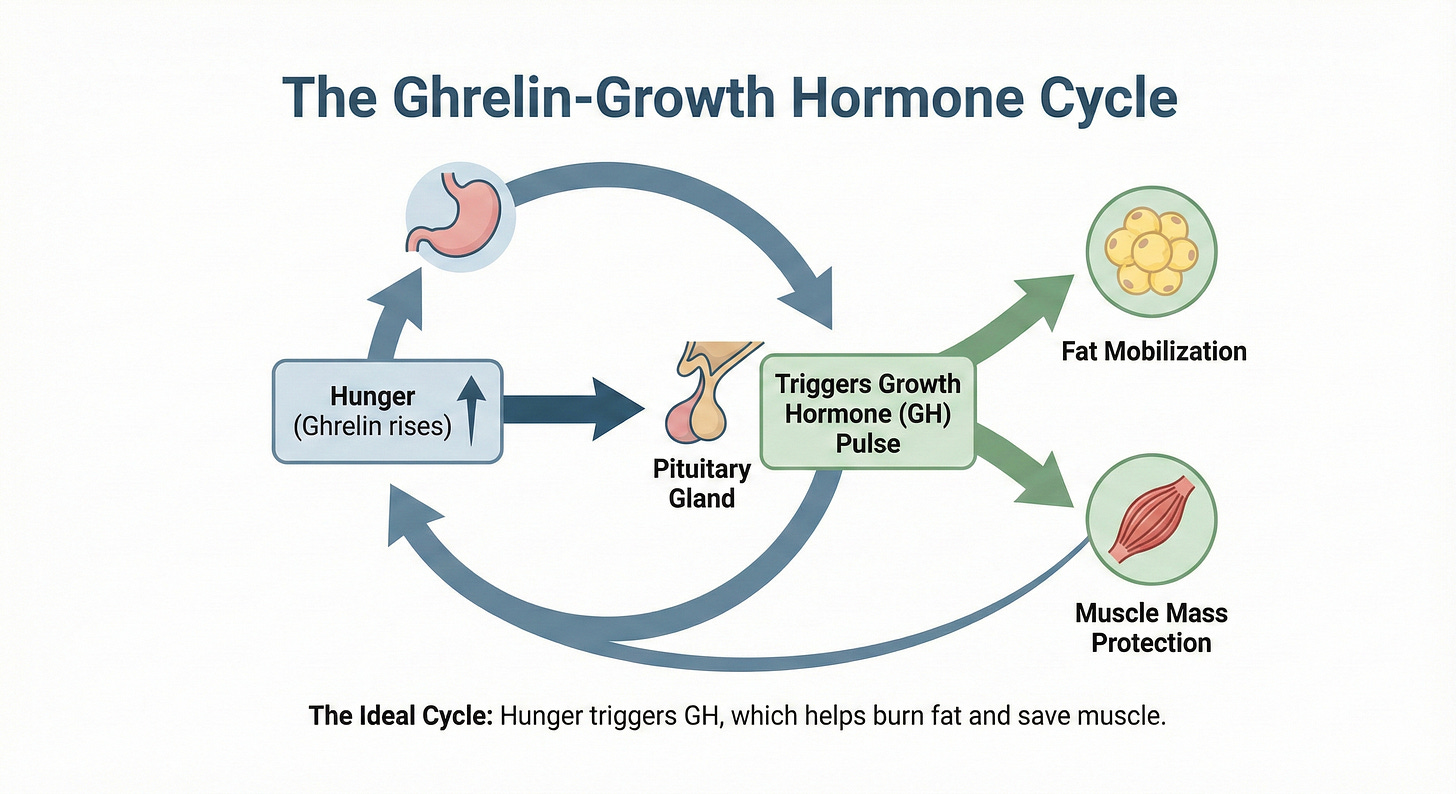
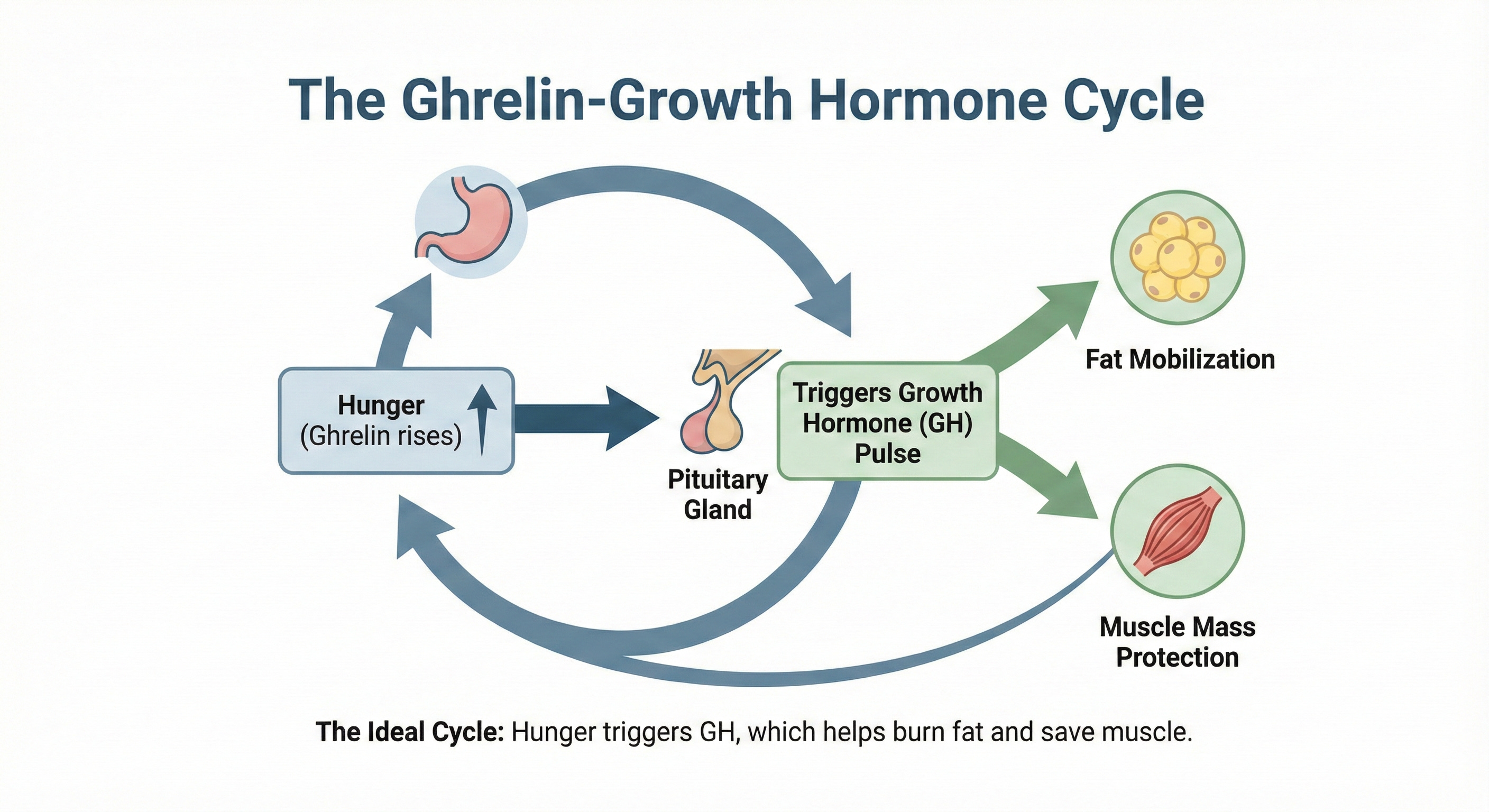
The Ideal Cycle: You get hungry (Ghrelin rises) -> This triggers a pulse of Growth Hormone -> GH helps mobilize fat for fuel and protects your muscle mass while you look for food.
In a healthy metabolism, Ghrelin isn’t just making you eat; it’s trying to keep you lean and muscular. [1] Physiology
(We are going to do a full deep-dive on the South Asian Growth Hormone crisis in a future post on GH and sarcopenia (referred below), but for now, just remember this: Hunger and Muscle-Growth are coupled. If one breaks, the other usually follows.)
The South Asian Paradox
Here is where it gets weird.
If you look at a South Asian individual with the “thin-fat” phenotype (normal BMI but higher belly fat/visceral adiposity), you would expect their ghrelin levels to be sky-high, driving them to overeat.
The reality is often the opposite. Research has observed that insulin-resistant individuals (a trait highly prevalent in South Asians) actually exhibit significantly lower fasting ghrelin levels compared to metabolically healthy controls. In studies of South Asian men, acylated ghrelin was found to be lower than in white Europeans of similar BMI, correlating with higher visceral fat and insulin resistance. [2] Ghouri et al., PLoS One
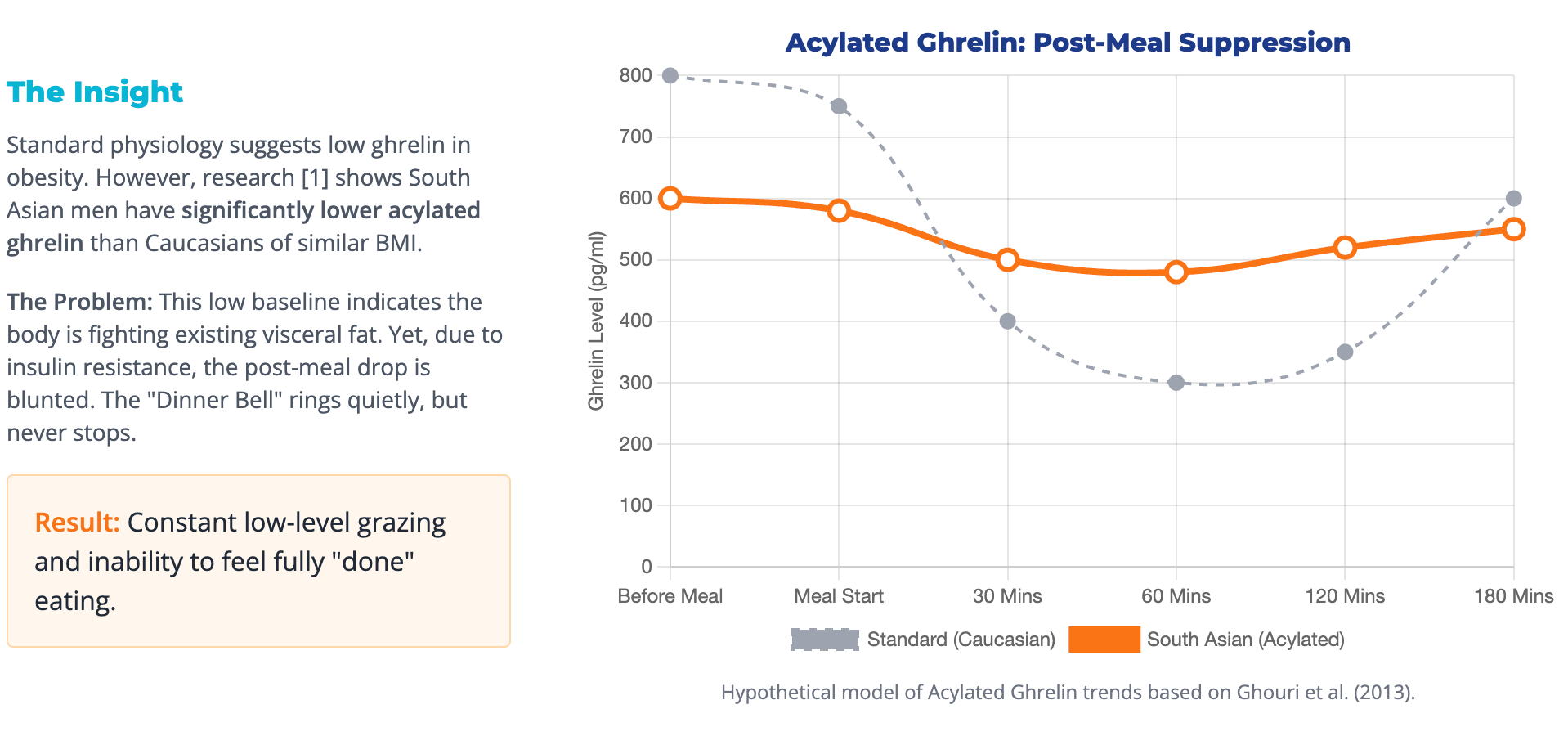
Why? It isn’t a “broken” gene, but a feedback loop. High baseline insulin (common in South Asians) suppresses ghrelin production. Your body knows you have plenty of energy stored as visceral fat, so it lowers the hunger signal.
The Problem:
Even though your baseline ghrelin is low, the system is malfunctioning:
The “Deaf” Brain: Despite low ghrelin, the brain often perceives starvation due to Leptin Resistance. You have high fat stores (Leptin), but the signal isn’t getting through. The “Aunty” in your metabolism panics and keeps hoarding energy. [3] StatPearls
The Growth Hormone Cost: Because your baseline Ghrelin is chronically suppressed and non-pulsatile, you likely lose that beneficial “Growth Hormone” spike. This is a potential contributor to Sarcopenia (low muscle mass)—a hallmark of the South Asian physique. [4] PMC
Revving a Fragile Engine, Beta-cell and Ghrelin
This “Low Ghrelin” state directly threatens your pancreas.
South Asians are born with “smaller engines”, as we discussed on last week’s post on beta cells. Autopsy studies comparing Indian and American pancreatic tissue found a striking 45% reduction in the proportion of large islets in Indian samples. Large islets are your metabolic “buffer”—without them, you have less margin for error. [5] PMC

Here is how Ghrelin fits in:
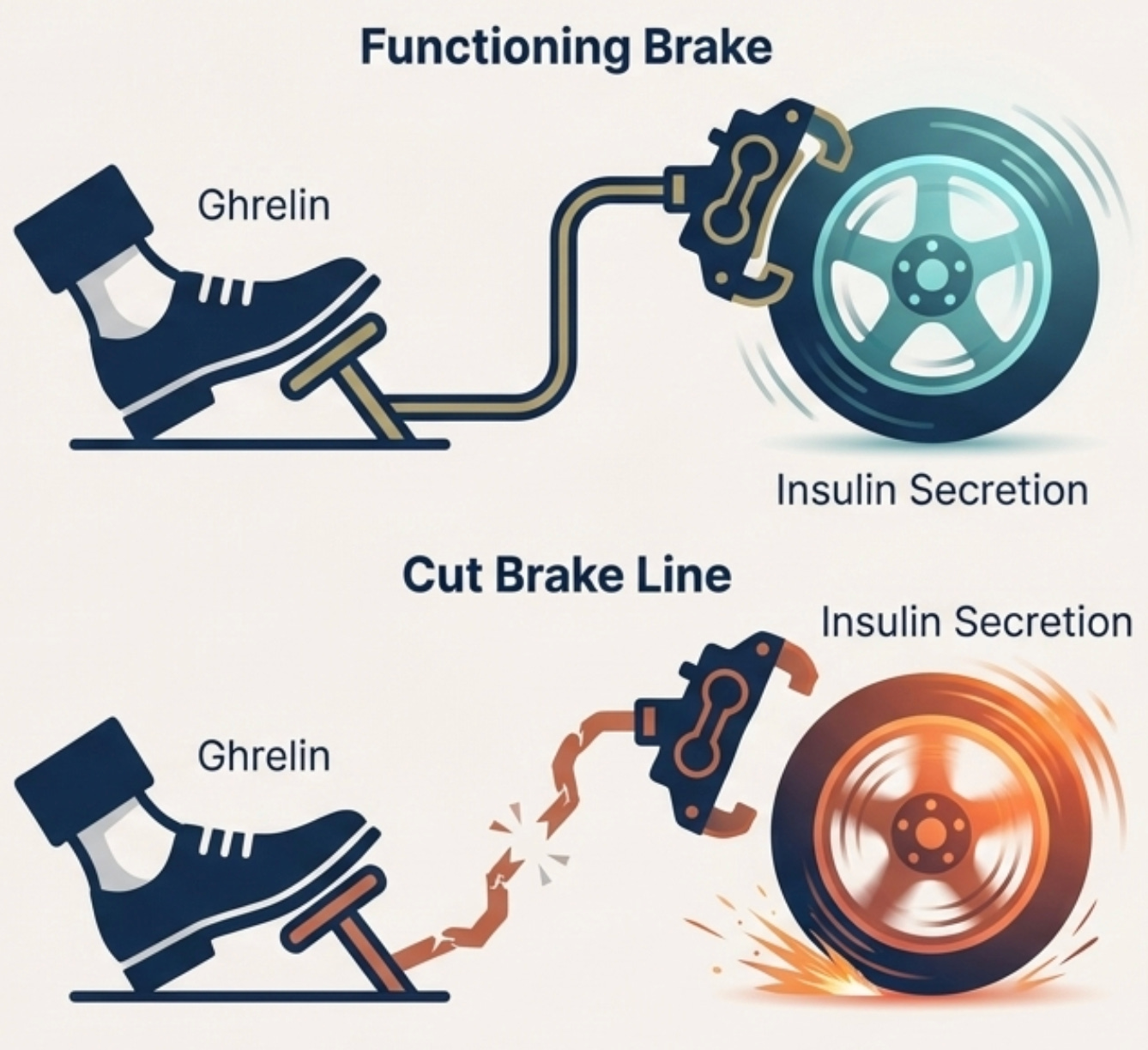
The Brake Pedal: One of Ghrelin’s physiological roles is to suppress insulin secretion. When you are hungry, Ghrelin tells the beta cells: “Stop pumping insulin! We need to release sugar, not store it!” [6] Tong et al., Diabetes
The Cut Brake Line: In the context of visceral obesity and low fasting ghrelin, this “brake” is weakened.
The Burnout: Without the Ghrelin brake, your already fragile (and smaller) beta cell reserve is left uninhibited, constantly leaking insulin. You are red-lining a small engine because the rev-limiter has been disconnected.
The Ghost of Famines Past
Why is your biology wired this way? The leading theory is the “Thrifty Gene” Hypothesis, specifically adapted to the Indian subcontinent.
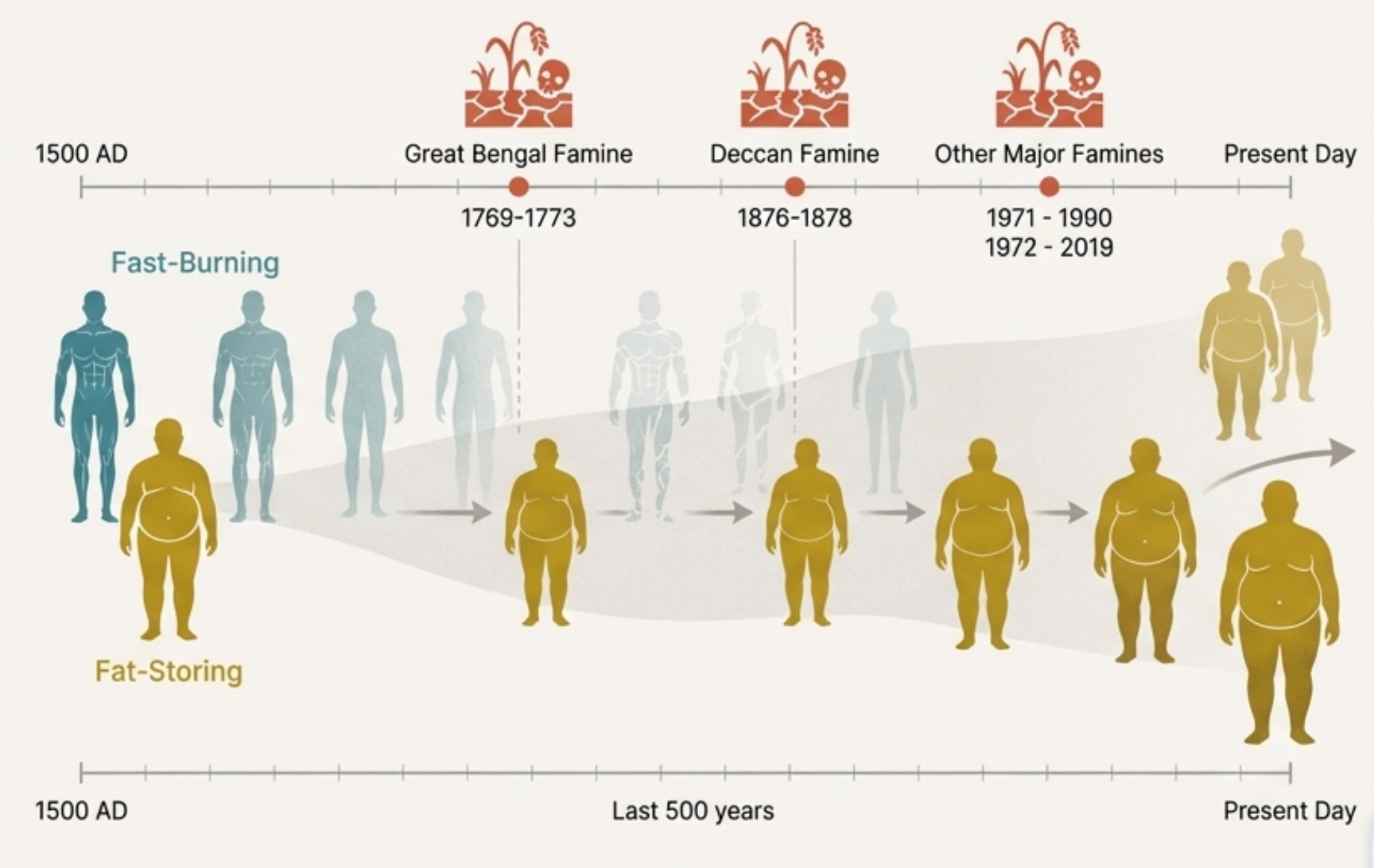
South Asian history is scarred by severe, repeated famines. In that harsh environment, a metabolism that burned energy quickly (high muscle mass) was a death sentence. The survivors were those who could store fat efficiently in the abdomen and survive on very few calories. [7] Research Open World
Warning: This is going to hit hard for some.
Think of your metabolism as the Aunty. The son (unfortunate beta) represents your modern biological reality: “I am full, I don’t need any more.” (This is your low baseline ghrelin).
But the Aunty represents your Genetics. She remembers the famine. She is terrified that if you don’t eat now, you might die tomorrow. She overrides the son, forcing energy into the system and storing it as visceral fat “just in case.”
(Really tried hard on that one.)
The Genetic Nature
This isn’t just behavioral; it’s written in the code.
While specific gene variants like Leu72Met have been studied (caveat: with mixed results), the South Asian phenotype likely faces a genetic “Double Hit”: [8] Frontiers
Beta Cell Fragility: Risk variants in genes like TCF7L2 that limit insulin capacity.
Hormonal Dysregulation: Epigenetic programming (often from low birth weight) that sets the “starvation” dial to high, prioritizing fat storage over muscle growth.
Now how do we tackle this? We’ll dive deeper below on the protocols we’ve developed to counter this including the melatonin effect, protein and what to eat when breaking fasts in the morning or after a log intermittent fasting session.