


First in a series on immunity, migration, and the biology being written across generations of the South Asian diaspora.
“Certain moves made long ago had produced all of them.”
— Kiran Desai, The Inheritance of Loss
Medicine has become obsessed with data in most good ways. Risk scores decide medication regimens. A biological age clock reads your methylation and rate of aging. An algorithm decides who gets flagged for screening and who doesn’t. I’ve built calculators like these myself. But more data is never the same as the right data, and even the right data is only carries half the story. The other half, what concerns me more, is the outcome that data connects to. does this number change what happens to the person in front of you? That question, what actually works for South Asians, and what doesn’t, is the whole reason Zinda exists.
Watch what happens when the right data isn’t there.
The UK’s standard cardiovascular calculator, QRISK, adjusts your risk score by whether you are Indian, Pakistani, or Bangladeshi, the same adjustment whether you arrived at 32 or were born down the road. The American pooled cohort equations were built on White and Black patients; the rest of us are mapped to the nearest approximation, in a silent gray invisble to metrics. Location, duration, the timing of every move: none of it is an input. So the coefficient knows the label. It cannot see time. Temporality is lost.
If our metrics are going to run medicine, and they are, they will have to learn to carry temporality: where a person lived, for how long, and at what age each environment arrived. This essay is about the system where that blind spot is most visible, and most fixable. The immune system keeps a legible record of place and time, written in markers we already know how to measure and outcomes we already know how to count. The heart and our metabolic machinery almost certainly keep similar records; the immune system is simply where the record is easiest to read, and where the feedback loop is easily established..
Picture a family at dinner in Los Angeles. The grandmother grew up in Delhi and came to California at 32. Her daughter made the same trip when she was seven. The grandson was born in LA (unfortunately a Dodgers fan) and knows Delhi through summer trips and voice notes. They eat the same dal and tell the same stories. In the database, all three fit into one categorical label as South Asian.
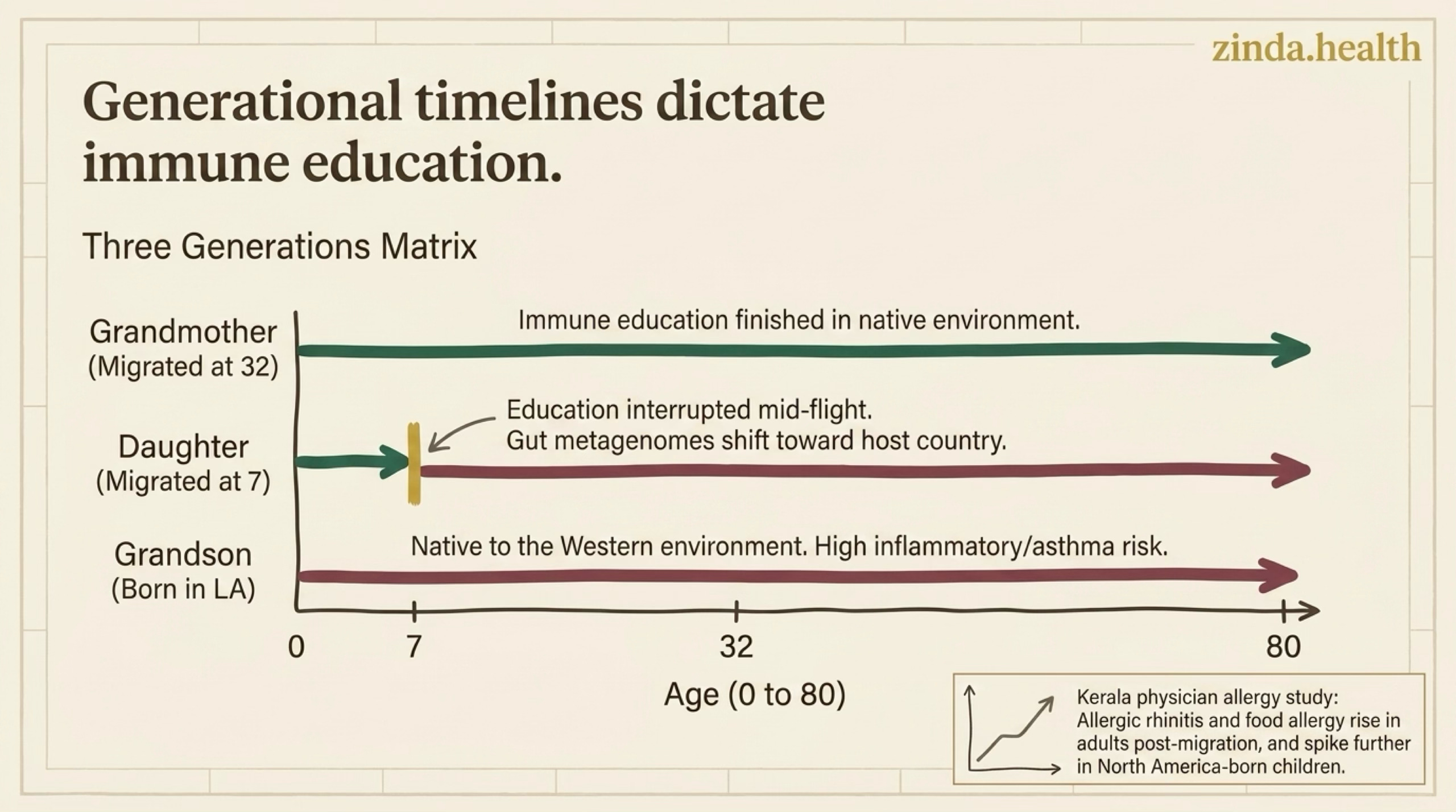
That word isn’t wrong. It carries ancestry, kinship, a family history that genuinely runs through three bodies. What it can’t carry is time. The grandmother’s immune system spent three decades learning Delhi before it ever met California. Her daughter’s was mid-education when the environment changed under her. The grandson’s has only ever known this one.
An immune system keeps a longer record than a passport.
For the first time, we have the tools to read that record: perform longitudinal biomarkers, intakes that can actually ask, models that can synthesize and hold a timeline. What was before a blurred immune canvas, gets painted with fine nuance and granularity. Telling a story of a person in ways we have never been able to see.
This series is about what they should be looking for.
One of the clearest clues comes from Ontario, where researchers followed 443,265 South Asian immigrants alongside other immigrants and non-immigrants. Immigrant children had less asthma than non-immigrant Canadian kids (incidence rate ratio 0.66, 95% CI 0.62 to 0.71) and less inflammatory bowel disease (IRR 0.47, 0.33 to 0.67).
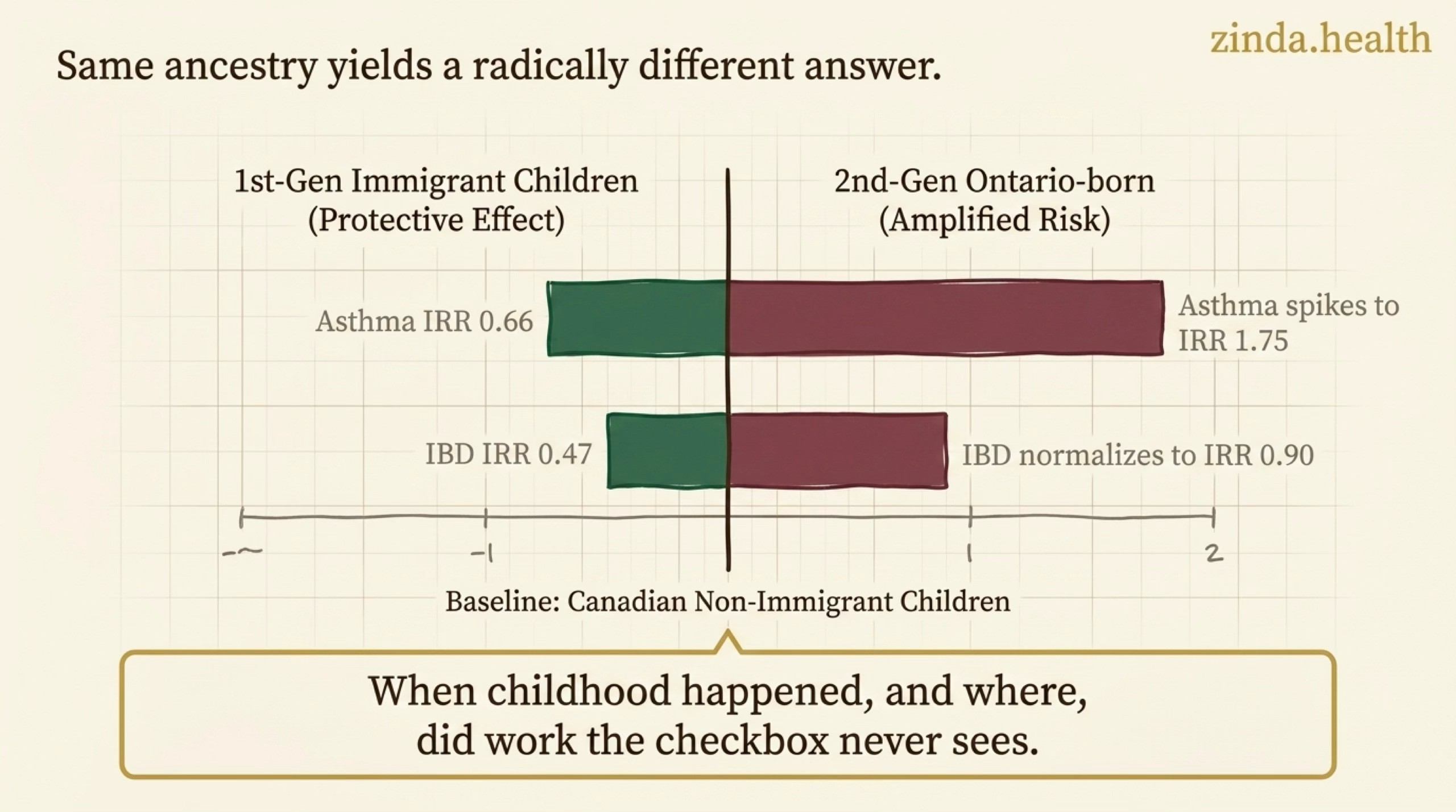
Then you turn the page to their Ontario-born children, and the picture flips. Asthma climbs above the Canadian rate, IRR 1.75. The IBD advantage thins to nothing, point estimate 0.90 with a confidence interval crossing the line of no effect.
Same ancestry. Different answer, in one generation.
A companion analysis of over two million immigrants from everywhere found each decade younger at arrival came with roughly fourteen percent higher IBD risk. Observational, not causal, and not SA specifically which is almost the point. It looks less like a South Asian finding and more like a migration finding we happen to be well positioned to study.
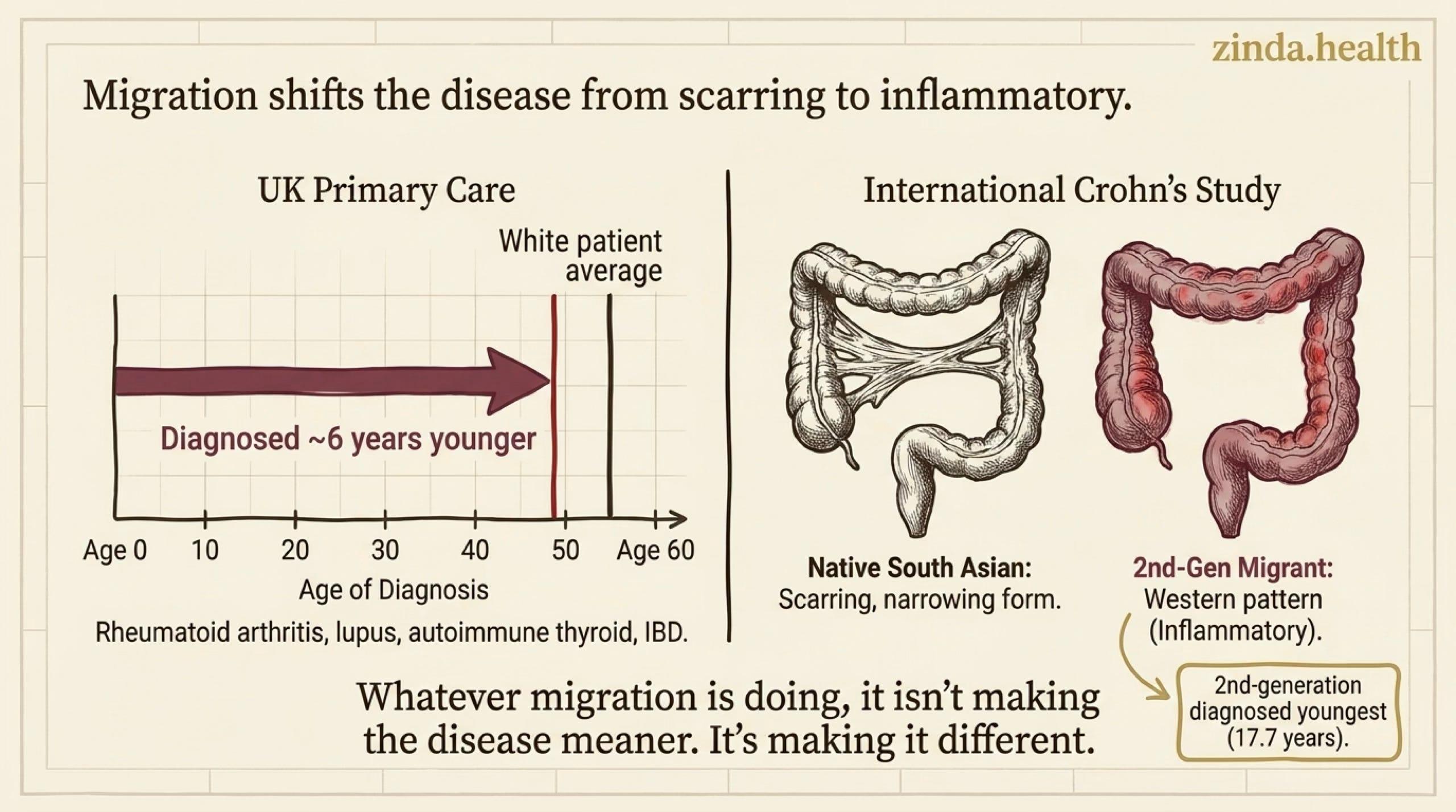
And the pattern isn’t only Canadian. In 4.5 million UK primary care records, South Asians were diagnosed with immune-mediated disease about six years younger than white patients. Diagnosed, not struck and records like these can’t separate the two.
The Crohn’s data is quite intriguing. The second generation was diagnosed youngest, with disease that looked more like the Western inflammatory pattern.
Native South Asians more often presented with the stricturing, complicating form (B2): the version that narrows the bowel.
The second generation was diagnosed youngest (median ~17.7 years) and was significantly more likely to show the non-stricturing B1 inflammatory pattern (OR 3.48), i.e., their disease looked like what gastroenterologists typically see in Western clinics.
Whatever migration does to the SA phenotype, it doesn’t make the disease fiercer.
It makes it different.
Which exposure did any of this? I wish it was that clear cut, but with the data we have its impossible to untangle antibiotics from air quality from what was in the microbiome, and I’d rather sit in that unknown than reach for a tidy genetic story.
Proportion, not power
Immune vocabulary is derived from war.
Defenses, invaders, surveillance, cells recruited to a front. Fine during an infection. Useless the moment the real question becomes judgment. And likely why so much is missing in this understanding.
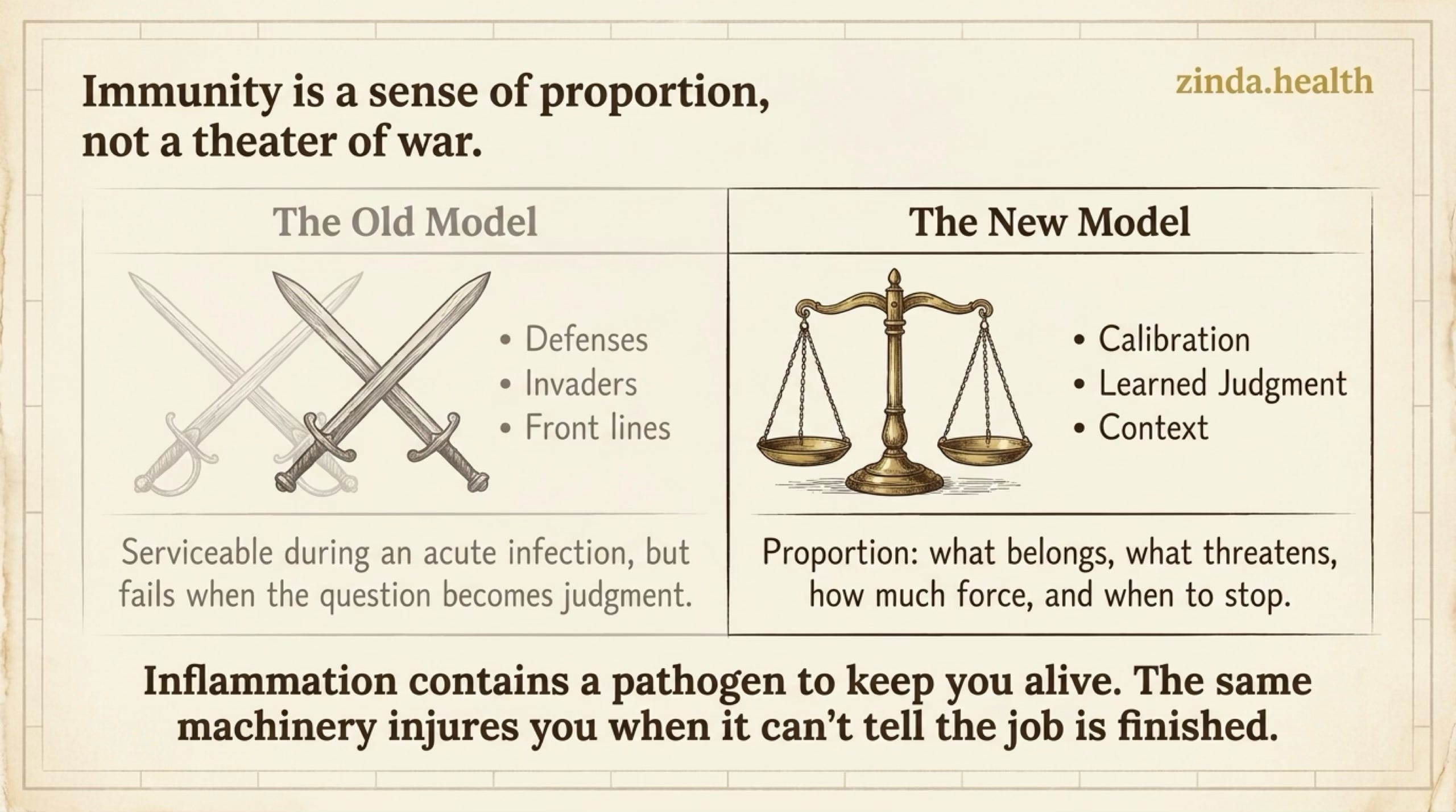
Inflammation closes wounds and keeps you alive; the same machinery injures you when it runs too long or fires in the wrong tissue, think autoimmune disease or inflammatory arthritis. What you want from an immune system isn’t strength but proportion:
What belongs?
What threatens?
How much force?
When to stop?
Immunologists call it calibration or learned judgment, built encounter by encounter out of everything the system has ever met. Each exposure leaving its footprint behind.
Migration doesn’t wipe that education. It adds a second one to further calibrate our immune systems. Edward Said described exile as a contrapuntal life, old place and new place sounding at the same time.Both lines keep playing.
So the history (and thus data) I want has an order to it:
What you inherited: genetics
What taught your immune system early: locations
What changed around you, and at what age: AQI, exposures, travel
What your tissues are reporting right now: biomarkers
Whether whatever got switched on can switch back off: treatment response and malleability
I’ve started calling that an immune biography, mostly because medicine tends to arrive at the last page. a raised CRP or a colitis diagnosis on a CT, well long after the earlier chapters of one’s history went quiet.
Seven is not thirty-two
People skip this part.
At thirty-two the grandmother’s immune system had done most of its learning. At seven her daughter’s was still in the middle of it. You can watch the difference in the gut: a Canadian study found longer residence and earlier arrival tracked with stool metagenomes closer to the Canadian-born group, down into function. Cross sectional data, but useful as the gradient is there.
It shows up in allergy too: among Kerala physician families who moved to North America, allergy rose in the same adults after migration, then again in their North America-born kids. One caveat is that this was self-reported data, in one professional community. But rhymes with the Ontario data above.
DNA travels between generations. So does immune education, through kitchens, households, neighborhoods, and the age at which each arrives.
That’s why, as we previously discussed in The Migrant Microbiome, migration is a biological event inside the gut, not a line in the social history.

The route is the variable
“South Asia to the West” describes almost nothing.
An engineer going Bengaluru to San Jose
A construction worker going Nepal to Qatar
Families landing in Bradford, in Melbourne
An Indo-Caribbean family in Queens
These are not one exposure. They are multifactorial, compounding across places, seasons, and hours of the day. And more than any clinician can hold in their head at once. Holding that complexity is exactly where machines esp AI could help. We’ll dive deep into that in parts 3 and 4.
Take sunlight.
Sylhet sits at 25 degrees north; London at 51. In Sylhet, the UV index stays high enough for skin to make vitamin D in every month of the year. In London it sinks below that threshold around October and stays there until spring, a vitamin D winter that no amount of lunchtime walks can fix. Skin built for the first place, now living and trying to adapt in the second: when studied on this, first-generation British-Bangladeshi women in London carried vitamin D levels of about 32 nmol/L vs 51 for the women who stayed in Sylhet, and 55 for their white British neighbors.Supplementation is vital.
Acculturation refuses to be a dial that turns one way. In MASALA, the biggest group, 73.8% of 771 participants, carried the lowest cardiometabolic burden while staying integrated into both cultures; the higher-risk classes were the more assimilated ones.
While UK Biobank flips this story: the highest risk sat with the most recently arrived, under five years in the country, a hazard ratio of 3.44, against 2.22 for the British-born and 2.14 for the longer-settled. Though I would argue this was a much smaller subgroup, about 400 people, and a metabolic outcome
Mostly it convinced me of this:
‘When’ someone arrived matters in some pathologies while in others may be a protection. Assimilation of diet, higher saturated fats and sugars might harm, but incorporation of athletics and a more active lifestyle might carry benefits not previously attained such as muscle mass and mitochondrial health.
What fat tells the immune system
The immune system listens to viruses and bacteria. It also listens to us:
Stretched fat cells
A leaky gut barrier
A liver storing things it shouldn’t
Here the metabolic story and the immune story stop being separable.
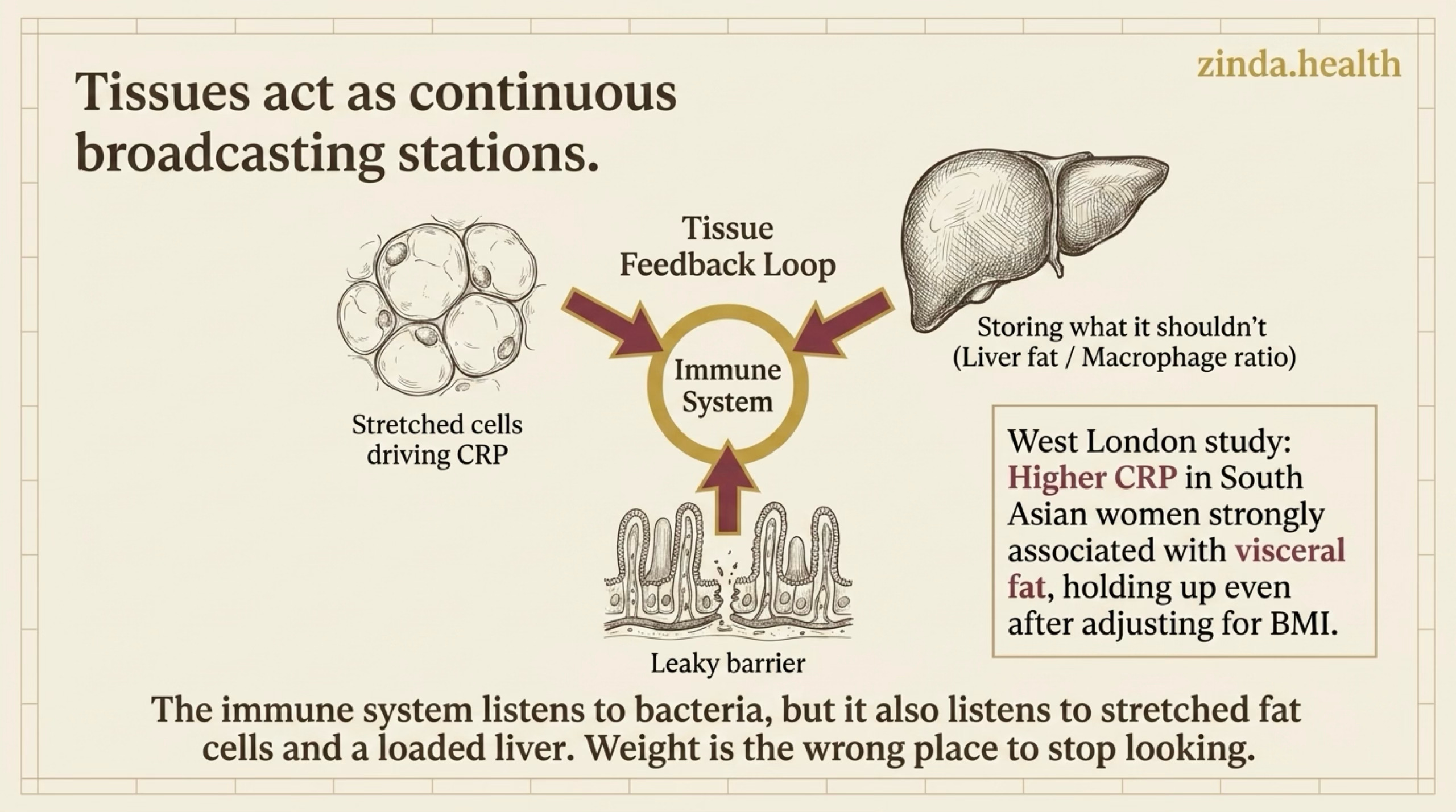
Back in 2001, a West London study of 113 healthy adults found higher CRP in South Asian women, and, the finding that lasted, CRP tracked with visceral fat even after adjusting for BMI, while its links to insulin and lipids dissolved once visceral fat entered the model. A 2025 cohort of 322 Asian Indian adults in northwest India found more liver fat, larger visceral adipocytes, and a higher inflammatory macrophage ratio in those with diabetes, albeit small cohort nestled in a specific region.
Neither study says weight is irrelevant. But both point to an underlying implication of adipocytes in the immune process, weight matters, and why targeting lower BMI matters.
The part we don’t know
Immunology used to draw a clean line: T cells and B cells remember, everything else just reacts. Trained immunity smudged that line, and this is the chapter where it’s easiest to lie to ourselves.
The famous experiment fed mice a Western-style diet and found lasting changes in their myeloid precursors through the NLRP3 inflammasome, with supporting work in human monocytes ex-vivo. Mice, though were Ldlr-deficient ones. It doesn’t show that a diet permanently rewrites a person, and it is absolutely not evidence for a South Asian risk gene, because we don’t have one of those.
The human evidence is stranger and smaller when it comes to immune memory. Five volunteers were deliberately infected with malaria, then cured; their monocytes went quiet during the infection, then came back primed, with epigenetic marks to match.
Even there the memory faded by seven months with epigenetic markers wearing off.
The clinical question underneath stays good anyway:
What has this immune system learned, what is it hearing now, and can it stand down?
