


On the metabolic architecture that makes us thin, fat, and fragile.
Due to the depth and detail of this article, I have decided to split it into two parts. First dives into foundational knowledge of how the south asian muscle works and the why. Part 2 will focus on interventions and protocols.
Secondly, I have some big news (some hints hidden in the post) on what is coming soon as we work on building a new framework for South Asian health and optimization.
Would love your feedback on these, as always!
In 2004, two scientists stood side by side in Pune, India, and posed for a photograph that would quietly revolutionize how we think about South Asian metabolism.
Dr. Chittaranjan Yajnik, an Indian diabetologist, and Dr. John Yudkin, his British collaborator, had identical BMIs: 22.3 kg/m². By every standard measure, they were metabolically equivalent. The photograph told a different story. When body composition was measured, Yajnik, the thinner-appearing of the two, carried 21.2% body fat. Yudkin carried 9.1%.
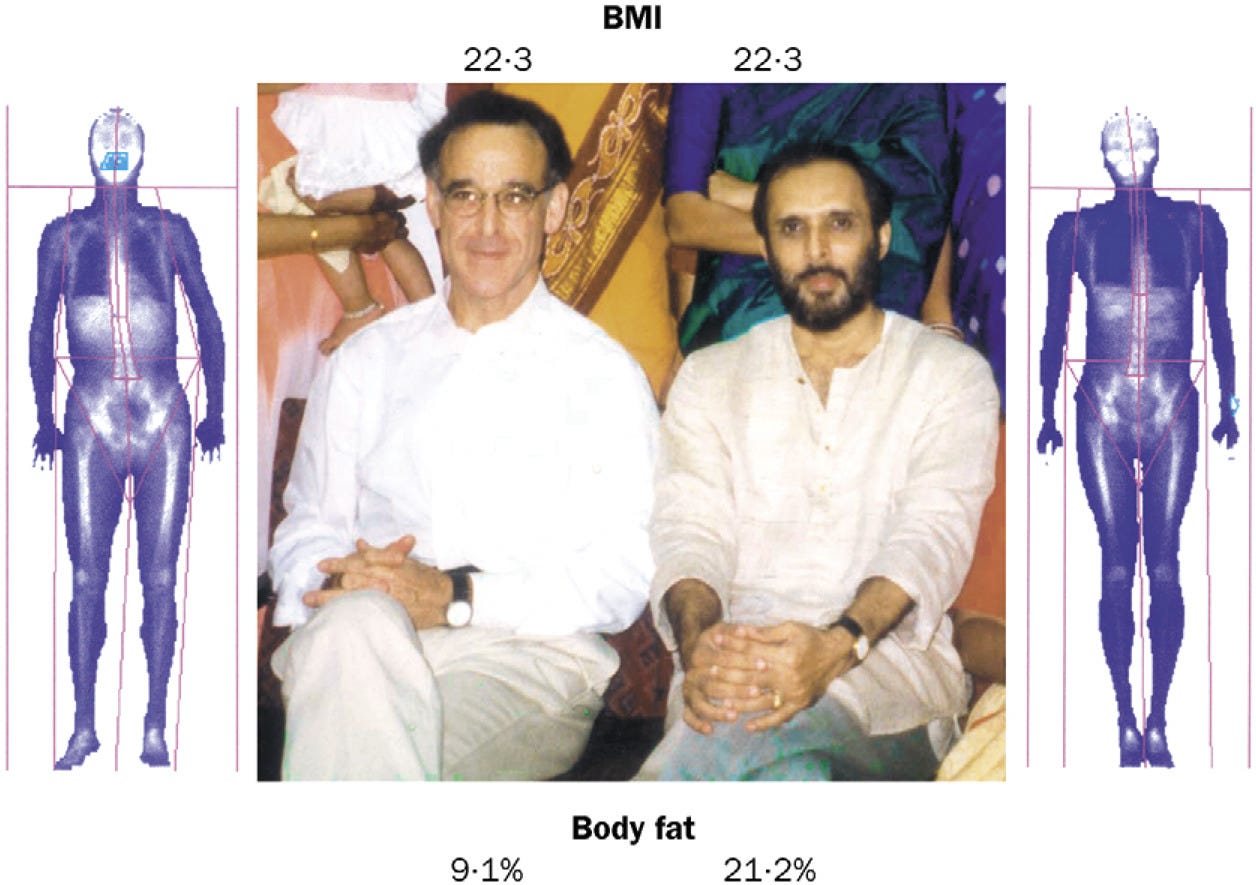
Same BMI. More than double the fat. The Yajnik-Yudkin Paradox, as it came to be known, captured something clinicians treating South Asian patients had intuited for decades: we are not built the same.
But here is what that famous photograph did not show, what no photograph could show: the corresponding poverty in Yajnik’s muscle tissue. The fat that his body composition analysis revealed was not merely present; it had displaced something. And that something, the lean mass that should have been there, the contractile tissue that burns glucose and generates power, was conspicuously, dangerously absent.
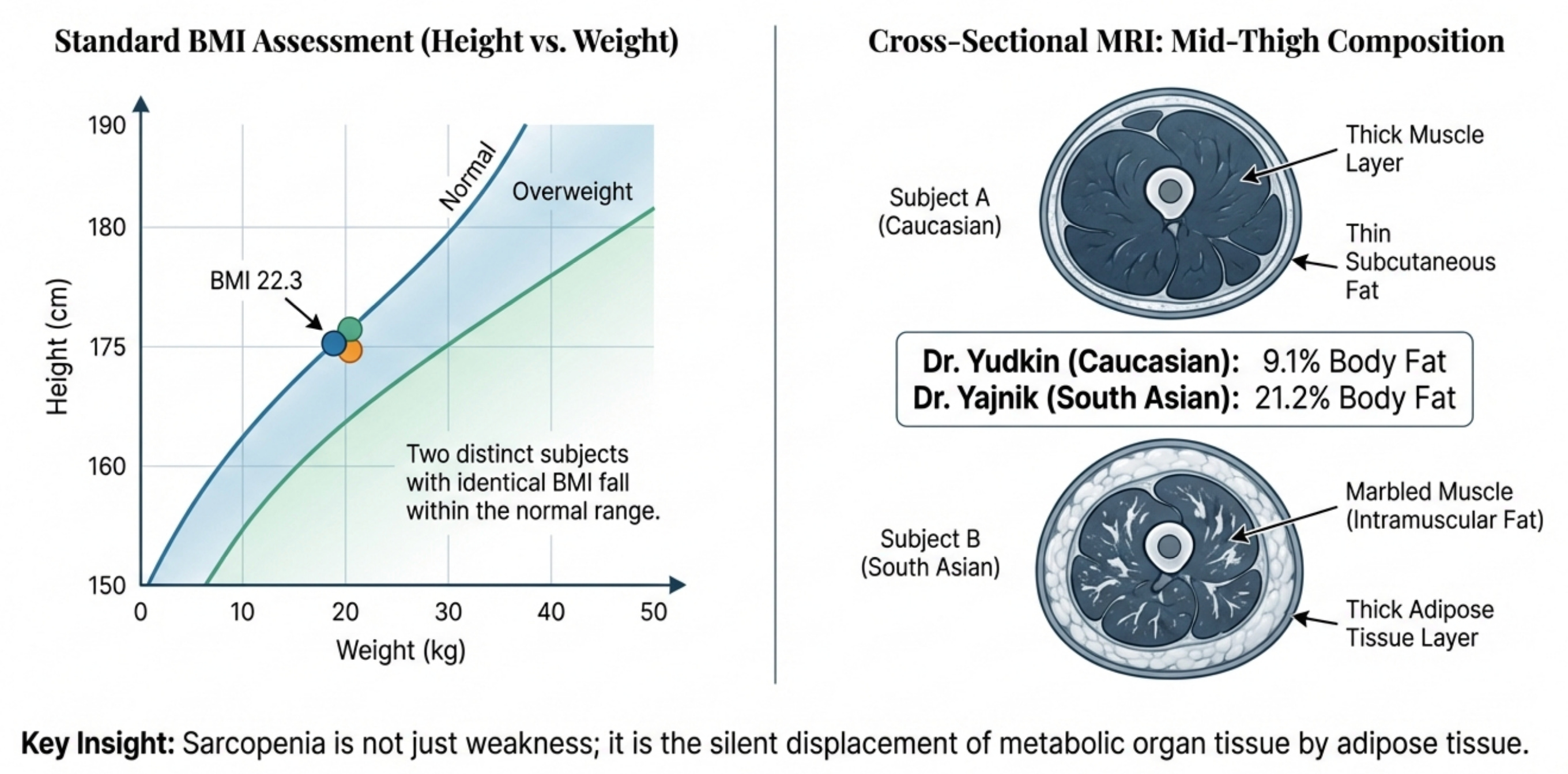
This is the story of that absence. Of how South Asians, from the moment of our first breath, are predisposed toward a peculiar form of metabolic fragility: abundant fat wrapped around insufficient muscle, a physiology optimized for surviving famine that now kills us in the age of plenty.
If you’ve been following our map-building project, the mitochondria, the beta cells, the adipocytes, the hormonal axes, this is where another critical piece snaps into place. Sarcopenia is not merely one more problem to add to the list. It is the structural foundation upon which all the other problems rest.
It is also a story about what we can do to rewrite this inheritance.
The Organ You Didn’t Know You Had
Before we go further, a reframe is necessary. When most people hear “muscle,” they think of the gym, of strength, aesthetics, the ability to lift heavy things. This is a catastrophic misunderstanding.
Muscle is not primarily a mechanical tissue. It is a metabolic organ, the largest in the human body, and arguably the most consequential for metabolic health. Skeletal muscle is responsible for approximately 80% of insulin-stimulated glucose disposal. When you eat carbohydrates, the vast majority of that glucose should be pulled into muscle tissue. If the muscle isn’t there, or isn’t functioning properly, that glucose has nowhere to go. It stays in the bloodstream, drives compensatory insulin secretion, and eventually overwhelms the system. The pancreas fails not only because it is inherently weak, but because the tissue that should be absorbing its signal has atrophied.
But muscle does more than absorb glucose. It is an endocrine organ, secreting a family of signaling molecules called myokines that regulate metabolism, inflammation, and even cognition throughout the body. Interleukin-6 (IL-6), released during muscle contraction, improves insulin sensitivity and mobilizes fat. Irisin converts metabolically inactive white fat into thermogenic brown fat. Brain-derived neurotrophic factor (BDNF) supports neuroplasticity and cognitive function. When muscle contracts, it is not merely generating force, it is broadcasting hormonal signals that coordinate systemic health.
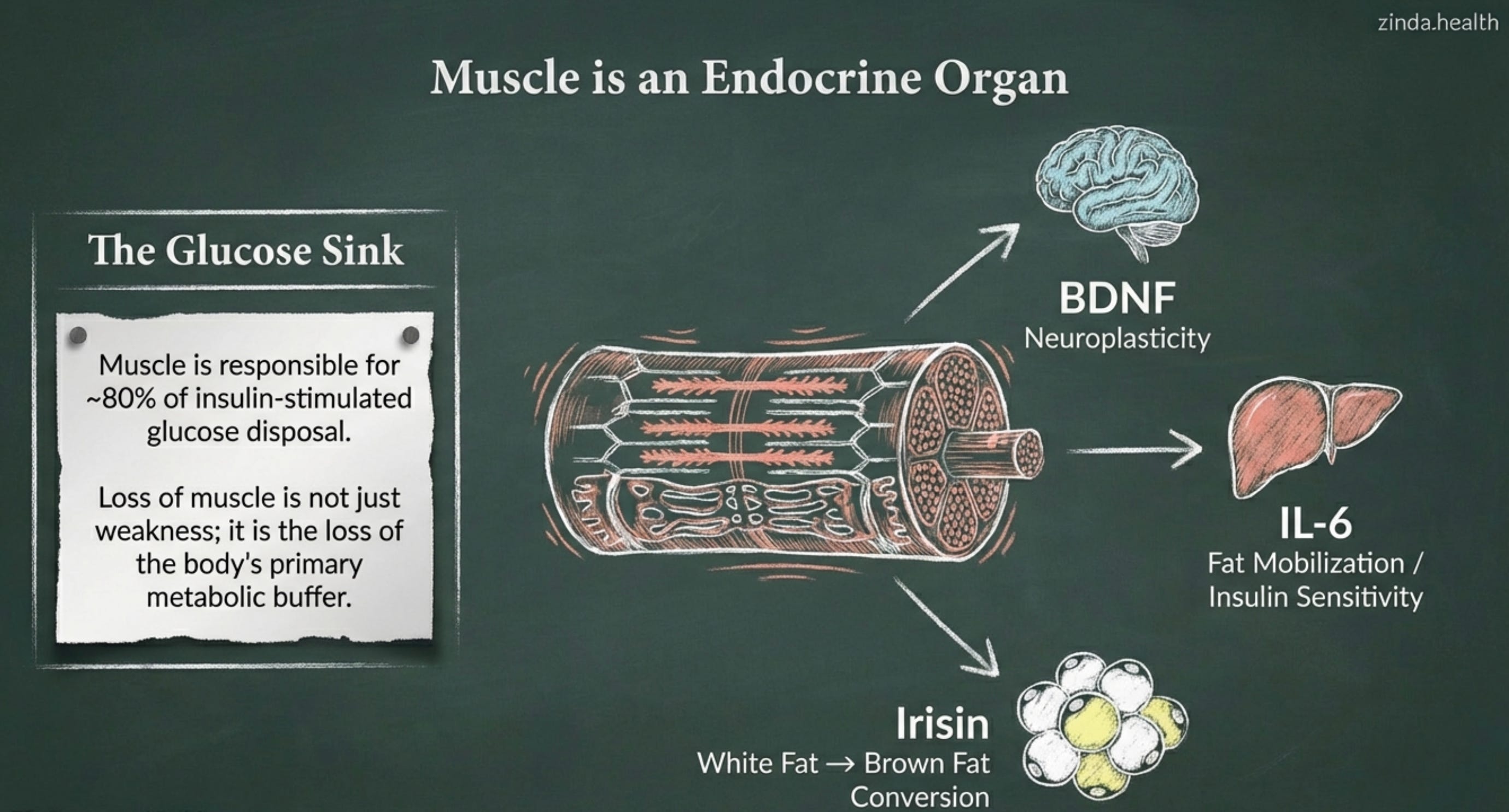
This reframes sarcopenia entirely.
Losing muscle is not just “getting weak.” It is organ failure, the progressive loss of a tissue that regulates glucose, modulates inflammation, and communicates with every other organ system in the body.
When a South Asian loses muscle mass, they are not just losing strength. They are losing the metabolic buffer that protects them from diabetes, the inflammatory regulator that protects them from cardiovascular disease, and the glucose sink that their fragile beta cells depend on.
The liver fails visibly; we call it cirrhosis. The kidney fails measurably; we track creatinine and GFR. But muscle fails silently, over decades, and we have no routine screening for it. By the time weakness becomes apparent, the metabolic damage is already done.
This is the organ we need to protect.